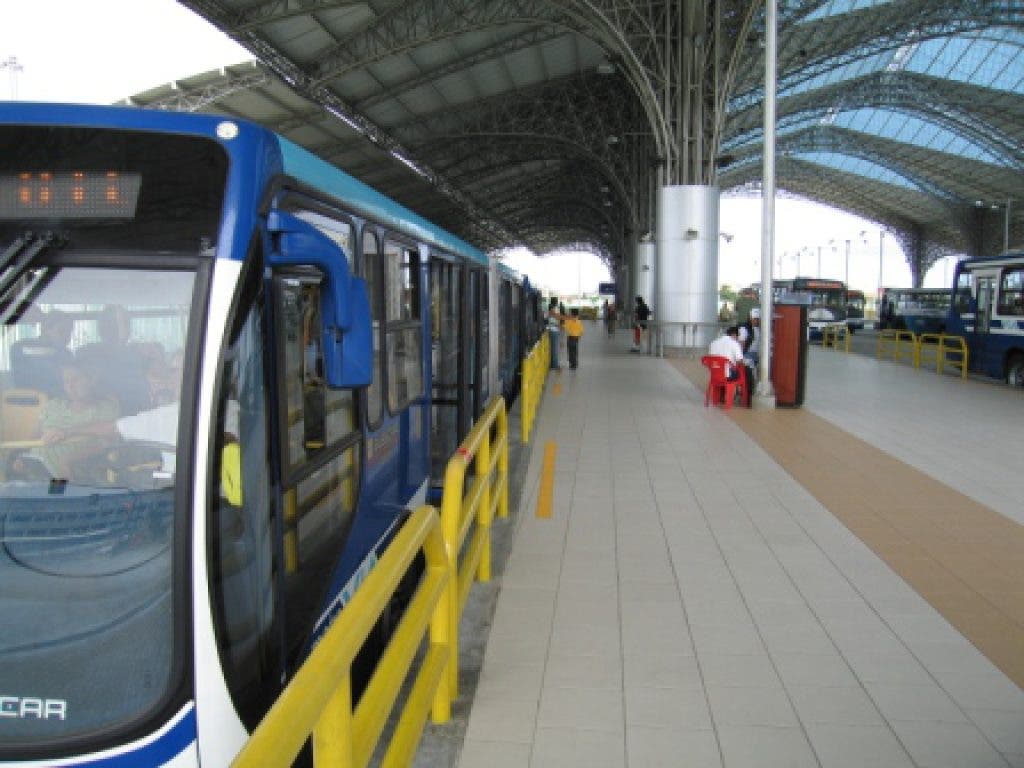
In what appears to be preparation for supporting a vote against Loudoun’s participation in phase two of the Dulles Corridor Metrorail Project, if that becomes the most politically tenable thing to do, some members of the Loudoun Board of Supervisors have turned to an alternative that many thought was taken off the table long ago—whether buses are a better alternative, at least for now.
Supervisor Ken Reid (R-Leesburg) uttered a single word during a Metro work session May 3 that made his views clear after County Chairman Scott K. York (R-At Large) asked how best to expand transportation capacity with few options to widen pavement in east-west corridors between Loudoun and job centers to the east.
“Buses,” Reid said, with a chuckle.
Several years ago, Reid co-founded notollincrease.org with Chris Walker, a developer who died in 2011. Walker constructed the 1 Dulles Corridor building in Fairfax, which he struggled to lease. The building sits near the Dulles Toll Road/Hunter Mill interchange where planners declined to place a rail station. Walker, at some point, became an opponent of the rail project.
The choice between buses and rail appears to have been made in 2002 when all the local project partners chose rail instead of an alternative proposal for bus rapid transit, commonly referred to as BRT. From that point on, the planning and financing has focused on rail.
It may come as no surprise that County Chairman Scott K. York (R-At Large), who has consistently expressed support for rail as long as project managers do not favor unions for the construction contracts, voted in support of rail then.
What may be surprising is that Supervisor Eugene Delgaudio (R-Sterling), who often refers to the rail project as a "boondoggle," joined the board on a unanimous July 15, 2002, vote calling for the elimination of BRT as the initial phase of the rail project.
In those days, Frank Wolf (R-10)—who in recent years has been quiet about additional federal funding for the project and has called for a permanent inspector general for the Metropolitan Washington Airports Authority, the group tasked with construction—supported BRT. Over the years, reporters and editors in the region have attended numerous editorial meetings where Wolf pushed for bus service as a first step to ultimately bringing rail to .
"Establishing the BRT is critical to helping solve the region’s transportation problems," Wolf said in a statement from his office after an infusion of money to study BRT. "It is a necessary first step in getting rail to Dulles."
Wolf has been the primary go-to person in Congress for funding to study various aspects of the project, including whether BRT would be a better first phase.
But in 2002, after all the local jurisdictions voted for rail instead of BRT, Wolf relented and has since supported the rail project, working to help get the federal government to pitch in a large share for phase one. Wolf told a group of McLean residents in 2006 that the public favored rail, according to a story in the Connection Newspapers, so he would focus on making that project the best it can be.
As someone familiar with Wolf's position recently put it, with respect to BRT, "That ship has sailed."
Wolf also told residents during that 2006 meeting that he favored MWAA’s control over the project.
"MWAA has handled some very big projects on time and on budget," said Wolf told resident, according to the Connection story. "The state has not done that."
Wolf's recent actions calling for an MWAA IG appear to show at least a reconsideration of that stance. He requested an audit of phase two of the project in March.
The congressman, who is up for re-election this year, has not indicated whether he would push for federal money for phase two——but his office has in the past pointed to the previous agreement with the federal government on phase one, which many leaders at the time said would be the only federal funding for the Dulles rail project. Wolf helped secure that federal funding, which amounted to $900 million, or about one-third of phase one's $2.7 billion cost.
Despite those past debates over rail and bus service, the Loudoun board has now launched the conversation anew. There are good questions about whether residents’ commutes via transit will cost more or take more time. But the costs and fees of local transit service, provided by Virginia Regional Transit, are being mixed with costs for commuter service to DC, which the county provides using rider fees, muddying the discussion about the funding needs.
There is a legitimate question about how the county will fund rail and the VRE system. The county’s share of the gas tax revenue currently helps pay for VRE, but has also been eyed to fund rail. Supervisors have planned a work session to discuss funding alternatives, including the establishment of some sort of tax district.
While several supervisors have said they have not made up their minds on rail, their public comments suggest otherwise. At the moment, based on comments, at least five supervisors appear to lean against rail, while at least four appear to support it as long as MWAA does not tie a project labor agreement to construction contracts as a requirement or as a bonus incentive. Clearly, any supervisor could change his or her mind before the county’s July 4 deadline to commit to the project.
But that may depend on the information obtained during a series of work sessions, public outreach sessions and a planned public input session.
Public Outreach
- May 24, 7 p.m., gym, Ashburn
- May 30, 7 p.m., Freedom High School cafeteria, South Riding
- May 31, 7 p.m., Cascades Senior Center, Sterling
- June 2, 10 a.m., Loudoun Valley High School cafeteria, Purcellville
Public Input
- June 4, 6:30 p.m., boardroom, County Government Building, Leesburg
So, do residents want buses instead of rail? Who will fund the studies and engineering for bus service? How do you feel about rail? Or bus service? Let us know in the comments below and let board members know by contacting them directly.
Contact Info for the Board of Supervisors:
- Board of Supervisors, main email: bos@loudoun.gov
- Scott K. York (Chairman At-Large): scott.york@loudoun.gov
- Janet S. Clarke, Vice Chairman, (Blue Ridge): janet.clarke@loudoun.gov
- Suzanne M. Volpe (Algonkian): suzanne.volpe@loudoun.gov
- Ralph M. Buona (Ashburn): ralph.buona@loudoun.gov
- Shawn M. Williams (Broad Run): shawn.williams@loudoun.gov
- Geary M. Higgins (Catoctin): geary.higgins@loudoun.gov
- Matthew F. Letourneau (Dulles): matt.letourneau@loudoun.gov
- Kenneth D. Reid (Leesburg): ken.reid@loudoun.gov
- Eugene A. Delgaudio (Sterling): eugene.delgaudio@loudoun.gov
http://leesburg.patch.com/articles/lte-hidden-costs-behind-the-proposed-metro "Dulles Rail service will be constrained by the capacity of the Rosslyn tunnel -only 8 trains per hour will be provided in peak periods, four trains per hour other times. The Silver Line peak capacity will be 7,680 passengers per hour. By contrast, buses carrying 50 passengers each with 15 second headways on a bus lane can carry 12,000 passengers per hour and serve multiple origins and destinations on a far more energy efficient basis. More and more buses today use CNG, compressed natural gas, an abundant, relatively cheap domestic energy resource." Oh , and you might have noticed that people get stuck on trains in Rosslyn sometimes.
Kill Metro
Rail projects result in taxpayers subsidize the commuting costs for a few. If rail was an economical option, then it could be sustained with only user fares. Loudoun already carries enough debt and financial commitments due to growth. Adding a 25 year bond doubles the cost which would be at best $700 million assuming if you believe MWAA’s estimates. In other words, Loudoun doesn’t have the money for this project. Furthermore, Loudoun would be on the hook for a portion of Metro’s overall operational costs in perpetuity. The only fiscally prudent course is for Loudoun to defer this decision. Put the decision to a referendum and if the voters want this project then start saving the money in a sinking fund until the county can pay for it debt free. There is no rush to decide despite what the politicians say. The land will still be there. And folks in eastern Loudoun can use the Weihle station. And one more thing, Tim Kaine must be held responsible in November for his decision to place this project and our Dulles Tollroad fare structure into the hands of WMAA and out of Virginia’s hands all because he chose to spend his entire term fighting to raise taxes only to have them voted down repeatedly and for some declared unconstitutional.
VA Secretary of Transportation Sean Canaughton In a telephone interview Friday, Connaughton said the state was so unhappy with MWAA that it would rather finish building the Silver Line itself. “We are actively evaluating whether we can take the project over. These guys are a disaster,” Connaughton said. “We’re at the point, quite honestly, where we think we could potentially do it better, cheaper, faster.” http://www.washingtonpost.com/local/silver-line-needs-more-help-from-mcdonnell/2012/04/14/gIQAGBU4HT_story.html
Jim LeMunyon Member, Virginia House of Delegates 67th District --implicit in the $300 million request is that there are no other transportation projects in NorthernVirginia or statewide, for that matter, that are more important than Dulles Rail Phase 2. I don't agree, and I am concerned that earmarking funds for Dulles Rail in the state budget will result in the further postponement of many long-awaited transportation projects in Northern Virginia that would do far more to reduce congestion and encourage economic development than Phase 2 of Dulles Rail;
Buses have far less capacity than the letter writer states, mostly due to something we Northern Virginians are familiar with: traffic. Please don't cite the restricted access lanes of the Dulles Toll Road. The airports authority will never, nor should, allow that level of commuter us traffic to congest that roadway and choke off access for air travelers and airport employees. Also, there is simply far less demand from riders for buses, and there is ZERO return in economic benefits from the investment in buses , whereas Metro is proven to more than pay for itself.
1. Selective Search for Evidence: Gathering facts that support pre-determined conclusions, but disregard other facts that support different conclusions. 2. Premature Termination of Search for Evidence: Accepting the first alternative that looks like it might work. 3. Inertia: Being unwilling to change old thought patterns.4. Selective Perception: Prematurely screening out information not assumed to be useful. 5. Wishful Thinking: Wanting to see things in a positive light. 6. Recency Effect: Putting undue attention on recent information and experience while minimizing the value of information collected in the past. 7. Repetition Bias: Believing what's been stated the most often and by the greatest number of sources. 8. Anchoring and Adjustment: Being unduly influenced by initial information that shapes your view of subsequent information. 9. Group Think: Conforming to peer pressure or the opinions of the majority. 10. Source Credibility: Rejecting input from sources prematurely judged to not be credible (or not "cool" or "in sync with the way you do business.")
http://www.streetfilms.org/las-orange-line-bus-rapid-transit-plus-bike-path/
Buses are the better option. Have them run every 15 minutes. The ones I have ridden on in the past have people standing in the aisles and some people not even able to board the bus and waiting for the next. There is definitely a demand for buses. My two recent experiences on Metro have been a disaster. Delayed trains. Stations closed for elevator, track or escalator repairs. And that was just travelling on the weekend to sight see and see a hockey game. It is worse during the work week.
I am personally drilling into the exact details of Metro Bus vs Rail passenger capacity vs our needs now, but this much is well known: Our regional population density is inadequate to justify rail at this time, and this is particularly true in Loudoun County. The rules were bent by former Virginia governor Tim Kaine when he decided that this rail line would be built anyway. Certainly, ideal rail has more capacity than ideal bus. But bus can handle transit needs for a good long time. Given our population density, bus alone could have handled our needs for some time to come. After that, rail would have been appropriate. We should have used bus, until rail actually became appropriate. What we have been tricked into doing is to jump to rail prematurely. The result is that we are breaking the bank. On top of that, the price tag for this premature rail is two times what it should be, and certain political and economic operatives are fighting mightly to keep things that way. Certainly, with about a Billion and a half dollars of overcharge at stake, they have good reason to do so. Soon we will know what that's all about.
Rail is so a hundred years ago. Rail worked great in cities, a hundred years ago. Today many of us in Loudoun need broadband so we can work from home. Broadband and buses, THAT's the future, not metro!
So: for many millions of dollars from people who will not greatly benefit from it, Loudoun can add limited access to Fairfax county through two rail centers out in the east end of the county, that will unduly benefit certain landowners who do not pay any rail tax to pay back for this windfall.
Now subtract the money that would pour into Rail to Loudoun, and hmmmm, bus looks like the way to go. Now consider the alternatives. Taxis? Oxcarts? Rickshaws? Bicycles? Shoe leather? Moving sidewalks all over the county? What? You're not going to put rail all over the county in THIS lifetime.
Rosslyn tunnel has 26 trains per hour capacity, but that is fully used at rush hour now. So the rerouting of some existing trains only opens a few slots for Silver Line trains. Silver Line planned trains every 6 minutes rush. (That's 10 per hour, or 5 each way per hour.) https://en.wikipedia.org/wiki/Dulles_Metrorail According to WMATA in October 13, 2011: Metro Board Committee approves Blue & Yellow line service changesWMATA October 13, 2011 http://www.wmata.com/about_metro/news/PressReleaseDetail.cfm?ReleaseID=5062 "During peak periods, the tunnel between Rosslyn and Foggy Bottom is at capacity, with 26 trains per hour in each direction. The additional "slots" in the schedule will be made possible by routing three Blue Line trains in each direction over the Yellow Line bridge each peak hour." WMATA plan to start June 18, 2012: Rush+ Rush Hour Reinvented WMATA May 6, 2012 http://www.wmata.com/about_metro/news/rushplus.cfm? "Rush+ will improve service for nearly 110,000 customers on the Green, Yellow, Blue and Orange lines. Twenty-one stations will get more frequent service with six additional trains every hour of rush hour." - Meaning six slots per hour in the tunnel. So: no more than ten, and probably 8 Silvers per hour.
Please elaborate how Loudoun is going to move off the residents as its primary source of revenue and create a more equal balance with commercial.
If people come to Loudoun County by rail, how do they then get from Ashburn or Dulles to Purcelville, Middleburg, or Lovettsville? They either catch a cab, or they take a bus, or somebody drives out and gets them. For a business, bus is the best solution to this dilemma. So whatever this rail project brings IN to business in most of Loudoun County area, it involves bus transit - unless the benefit of rail is only within walking distance of the rail stations. No? Now, people living in Loudoun County, and going out to Herndon, Reston, Tysons Corner or DC, might take a bus to a rail station, or drive to a rail station and park. The parking fees are as yet unknown but they could park at a rail station. So some people will park at the station, others will drop off their family members or a car pool of some sort at a rail station, then maybe parking there or maybe going on elsewhere, and others will take a bus to the rail station. What is the difference if they took bus further out, all the way out, more of the way in, or all the way in from their outside places? So, other than the fact that this rail project is breaking the bank, I don't see one little local rail line making a big difference for business, except right in the station areas.
End of line metro stops never create businesses, they create housing. Look at the Vienna station for proof of that. How do we get more business to move to Loudoun? Change the laws to make the county more business friendly. That's how Fairfax did it. If we had the same laws as Fairfax, many more businesses would want to settle here. Loudoun is a better, cheaper, place for their employees to live. But our laws are not very business friendly. Metro won't help that one bit.